Weed Wednesday: Field Scabious
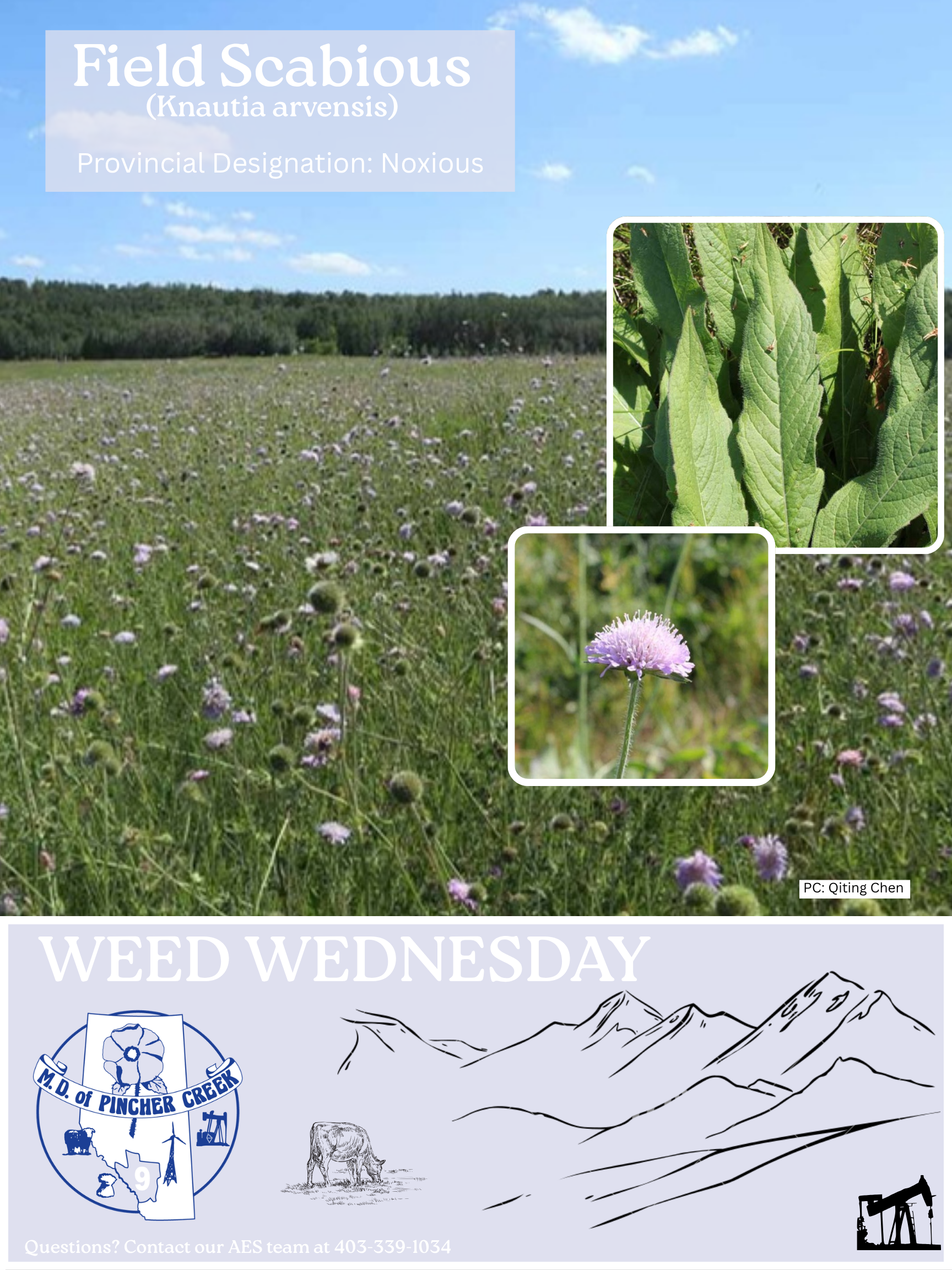
Field Scabious: Knautia arvensis
Noxious
Field scabious is native to Europe and was first introduced to Canada as an ornamental. It is a tall perennial that favours grassy areas and nutrient rich, moderately dry soils, and develops a deep tap root. Field scabious has hairy, erect stems, with one to several stems per plant. Leaves are hairy, and lobes are variable. Rosettes tend to be lance-shaped with pointed tips. Stem leaves are arranged opposite, deeply lobed, and attach directly to the stem. Lower leaves are 10-25 cm long and become smaller higher on the plant.
Field scabious' flowers are a composite of small, violet blue to purple florets clustered into a head resembling a single flower, and occur at the ends of stems. Flowers are hermaphroditic, meaning they have both male and female organs. When flowering is complete, the seed head is domed and covered with short, bristly hairs. The fruit of the seed is nut like, cylindrical and hairy. Seeds fall around the parent plant, and a single plant can produce up to 2000 seeds that can remain viable in the soil for several years. A native lookalike to field scabious is wild bergamot (Monarda fistulosa) also known as bee balm. This flower is very showy and extremely attractive to pollinators.
It is important to prevent field scabious from establishing as any infestation that has been allowed to go to seed will require multiple years of diligent control to eradicate. Because this plant favours grassy areas such as hayfields, it can be widely dispersed in baled forage. When possible, only purchase certified weed free forage to prevent the spread. It can invade undisturbed plant communities, but maintaining healthy plant communities can prevent invasion. Grazing is not an appropriate control method, as it is not palatable and seeds can be transported by animal movement. Discing before flowering is effective in cropland settings. Mowing is effective in preventing seed production but must be repeated during the growing season to prevent re-sprouting. Hand removal is difficult in anything but loose soils due to its deep tap root, as it usually results in the stem breaking off at ground level and the plant re-sprouting. However, any removal of seed heads is beneficial. Metsulfuron-methyl alone or in a product mix with Aminopyralid are registered for use on field scabious. Always check product labels to ensure the herbicide is registered for use on the target plant in Canada by the Pest Management Regulatory Agency. Always read and follow label directions. Consult our Agricultural Fieldman for more information.
Return to News & Events