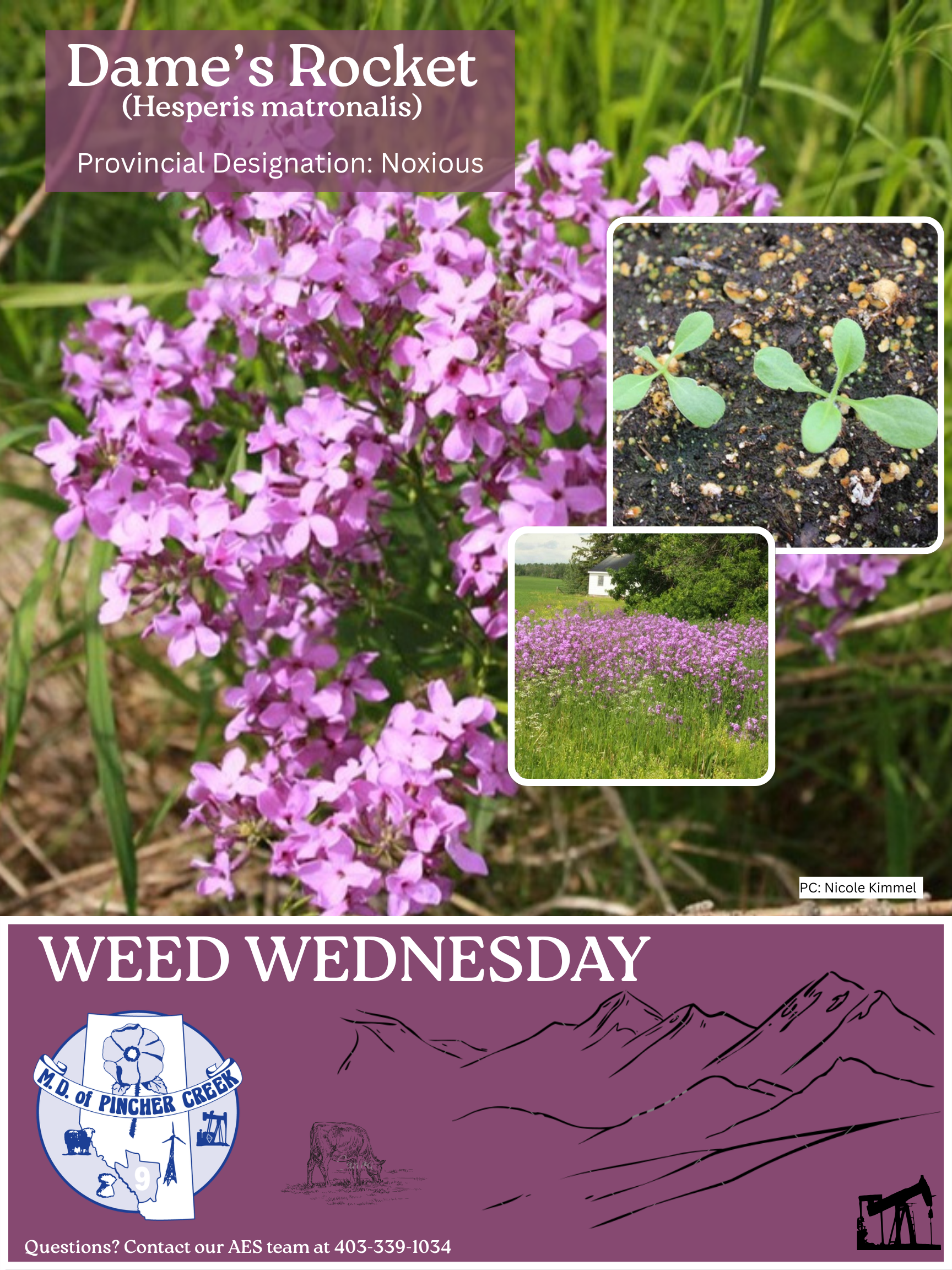
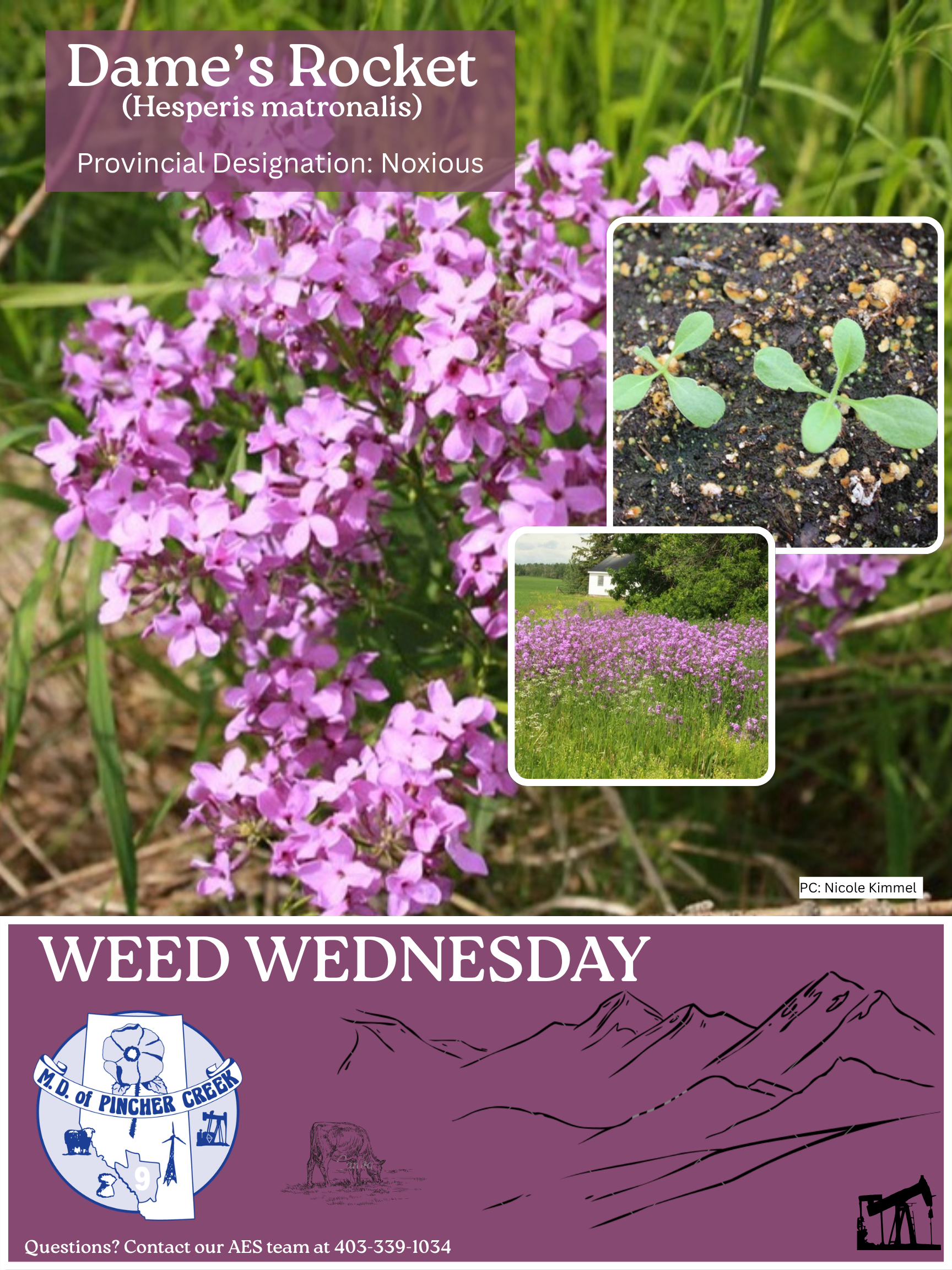
Weed Wednesday: Dame's Rocket
Weed Wednesday
Dame's Rocket: Hesperis matronalis
Noxious
Dame's rocket is a biennial or short-lived perennial that is native to Europe and SW Asia. It is a member of the mustard family and was first introduced to Canada as an ornamental. It has since spread throughout North America with the exception of the driest regions. The flowers are very fragrant, particularly in the evening. Because it is a biennial, it produces a rosette in the first year of growth, and a flowering bolt in the second year. It blooms in early summer (right now!), and withers and dies by late summer.
Dame's rocket requires moist soils, and does best is humus rich soils in wooded areas. It is tolerant of partial shade along forest edges. When flowering, dame's rocket is easily identifiable by its flowers that can be purple, lavender-pink, or white. Its leaves are alternate, lance shaped, and 1-4cm wide and 4-15 cm long. They are dark green, hairy on both sides, and have serrated edges. Dame's rocket can grow up to 1m tall, and occasionally taller. It is a prolific seed producer, up to 20,000 seeds per plant, and seeds can last 3-5 years in the soil.
Dame's rocket is often found within "wildflower" seed mixes. To prevent accidentally purchasing a seed mix with dame's rocket or other invasive species, always check the Latin names on the seed packets, and never buy a seed mix that does not include Latin names. Dame's rocket requires disturbance to become established. If dame's rocket pops up post disturbance, it is important that is removed quickly as it can out compete native vegetation. Grazing is not a suitable control method as its palatability is unknown. Cultivation is not a suitable control method. Hand pulling is the most effective method of control, as roots easily come out of moist soils, or can easily be dug out. Plant density may increase the year following removal due to disturbance, however, repeated hand pulling will exhaust the seed bank. There are currently no selective herbicides registered for use on dame's rocket. Contact your Agricultural Fieldman for more information.
Return to News & Events