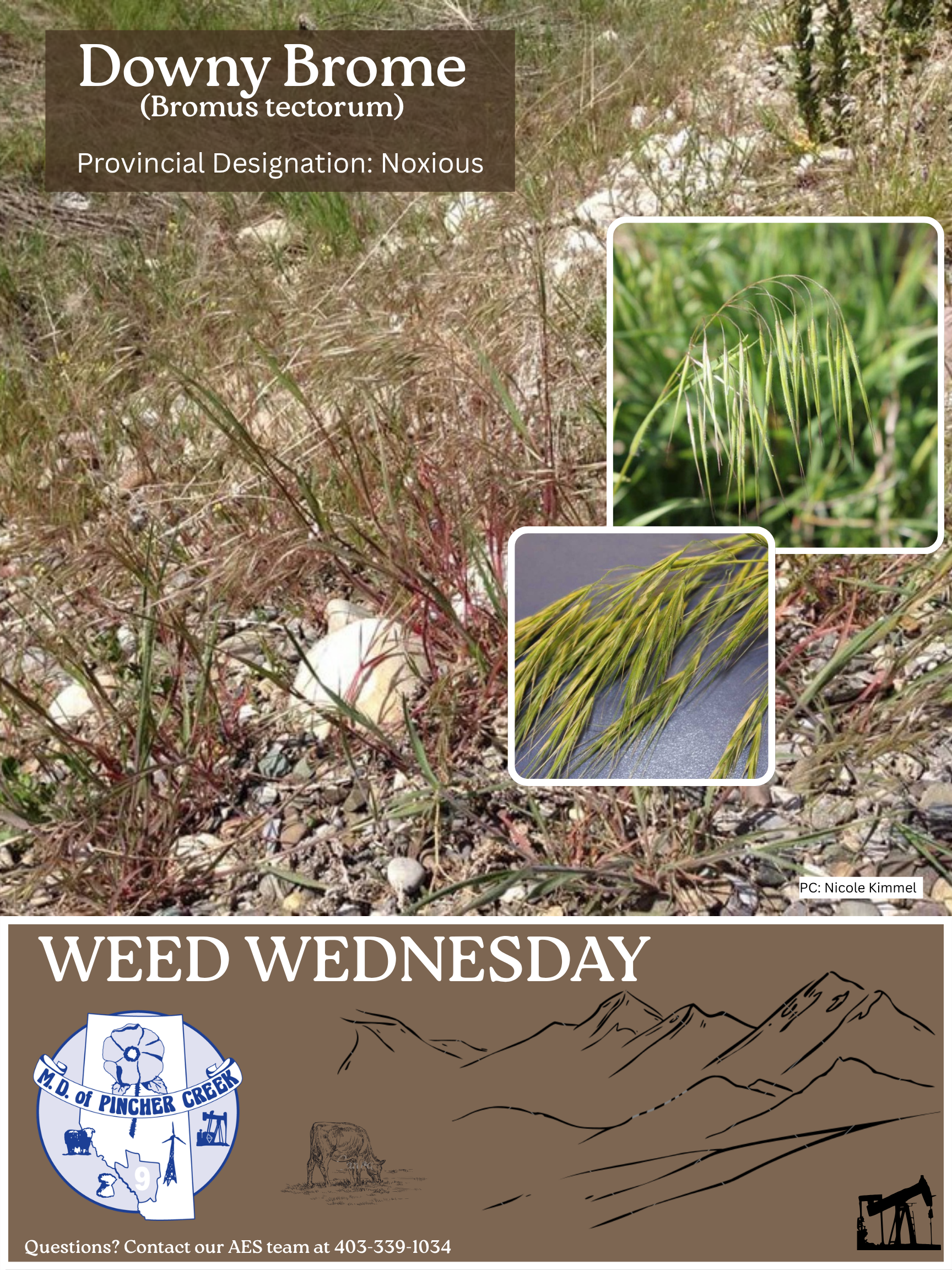
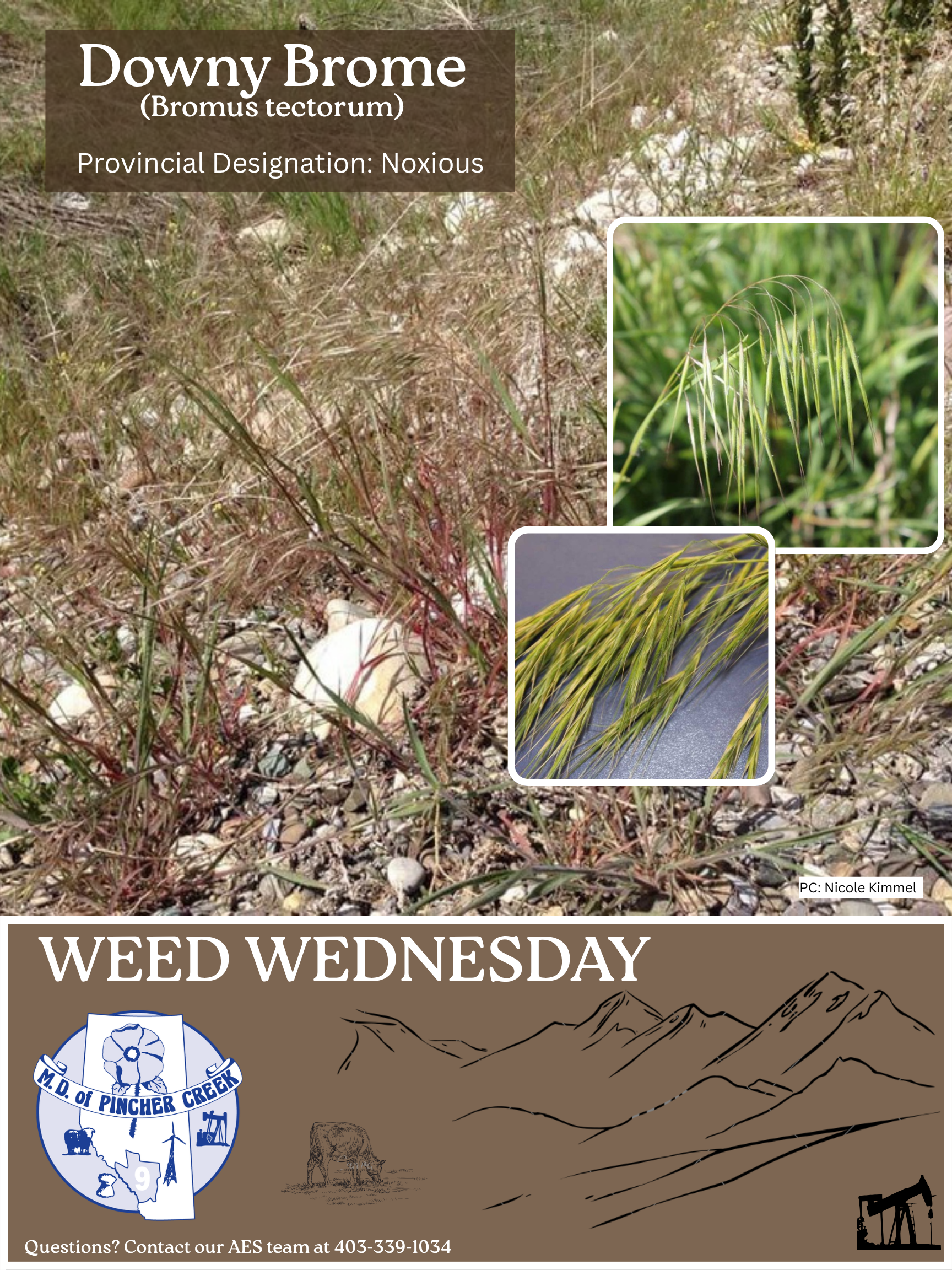
Weed Wednesday: Downy Brome
Weed Wednesday (Thursday this week!)
Downy Brome: Bromus tectorum
Noxious
Downy brome is an annual grass, typically a winter annual, but can behave as a summer annual when early spring or fall moisture occurs. It is native to the Mediterranean and Southwest Asia, but now occurs throughout most of Canada, the U.S. and northern Mexico. Downy Brome is incredibly aggressive in dry grasslands, especially when the landscape is over grazed. Downy Brome is very well adapted to frequent fire regimes and accumulates litter over the growing season that is highly flammable. Its seeds can survive low-intensity burns, and it is a strong competitor post-fire.
The ideal conditions for growth are cool, semi-arid environments with precipitation that peaks in late fall or early summer. It inhabits coarse textured sandy or deep loamy soils with sunny, south and west facing slopes. It is often found on roadsides, disturbed sites such as gravel pits, and in rangeland post-disturbance. Downy brome varies in height from 10 to 70 cm, with slightly hairy stems. Seedlings have bright green and soft hairy leaves, and all parts of the plant turn from green to purple to brown/tan as it matures. Downy Brome's inflorescence is a drooping, one-sided panicle with 5 to 8 florets.
The best method of controlling Downy Brome is prevention. Prevention can be done by encouraging resilient ecosystems, cleaning equipment before transporting, and purchasing weed-free forage. Additionally, checking shoelaces, clothing and pets after traveling in infested areas can help stop the spread. Do not allow Downy Brome to establish in an area post disturbance, as it is very persistent once established. Once established, controlling downy brome requires a combination of methods deployed throughout the growing season, over many years. Effective control must remove live plants, prevent seed formation, and control seed germination & emerging seedlings. Grazing is an effective control method, but only in the spring while plants are still green, as palatability decreases as the plant matures. Grazing can prevent seed production but must be paired with other methods. Sowing and fertilizing desirable species to compete with Downy Brome is effective. Mowing is not considered effective as plants may be at different life stages and mowing may further spread seeds. Hand pulling is effective for small infestations and must be repeated throughout the growing season. Get as much of the root system as possible and bag all parts of the plant and dispose in the landfill. Chemical control is an effective tool in managing Downy Brome. Indaziflam is registered for use in both industrial and range and pasture settings and will provide long term residual control. Glyphosate is also registered for use on Downy Brome; however, it is not appropriate for use in settings where bare ground is not desired. Consult with your Agricultural Fieldman for more information.
Return to News & Events