Weed Wednesday: Blueweed: Echium vulgare
Weed Wednesday: Blueweed: Echium vulgare
Noxious
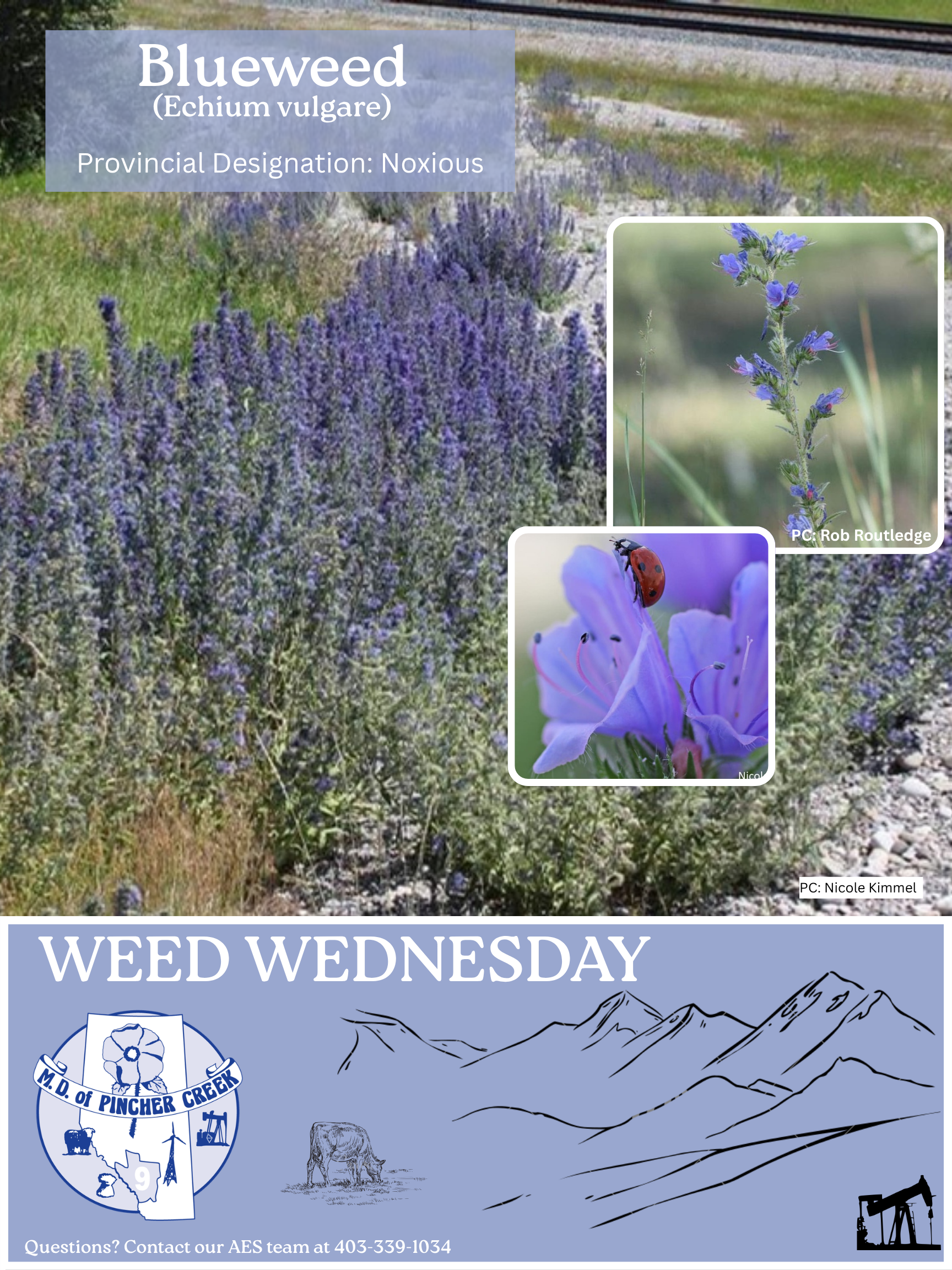
Blueweed is a biennial (or short-lived perennial) that produces a low growing rosette of hairy leaves in its first year, and a flowering bolt in its second year. This species is native to Eurasia and reproduces by seed only. Each plant can produce 2,800 seeds in a single lifecycle.
Blueweed is well adapted to dry, rocky, and shallow soils. However, it does well in various soil types and pH but does not tolerate shade and prefers south facing aspects. Both stems and leaves are hairy, and there may be one to several stems per plant. The stems are 30 – 80 cm tall, and covered with dark flecks at the bases of some hairs. Leaves are lance shaped and range from 6-25cm long, alternate around the stems getting smaller moving up. Blueweed flowers contain both male and female organs (hermaphroditic), and arranged on the upper side of short, arching stems. Flower buds are reddish-purple and become a bright blue upon opening.
Blueweed seed can remain viable in the seed bank for several years, meaning preventing this species form going to seed is key.
Blueweed is unpalatable to grazers and is potentially poisonous due to toxic alkaloids. Control methods of Blueweed range from cultivation, mechanical and chemical. Mowing can deplete root reserves and prevent seed production but cut stems may re-sprout so repeated mowing is necessary. If seed heads have formed, hand pull or cut the plant just below ground level, bag the plant, remove and burn. Mecoprop-p (in a product mix with 2, 4-D and Dicamba) is registered for use on Blueweed. If you are looking for a native-look-a-like that is great for pollinators, Smooth Blue Beardtongue (Penstemon nitidus) is a striking, early blooming perennial. Consult with our Agricultural Fieldman for more information.
.jpeg)
Return to News & Events