Weed Wednesday: Common tansy
Weed Wednesday: Common tansy: Tanacetum vulgare
Noxious
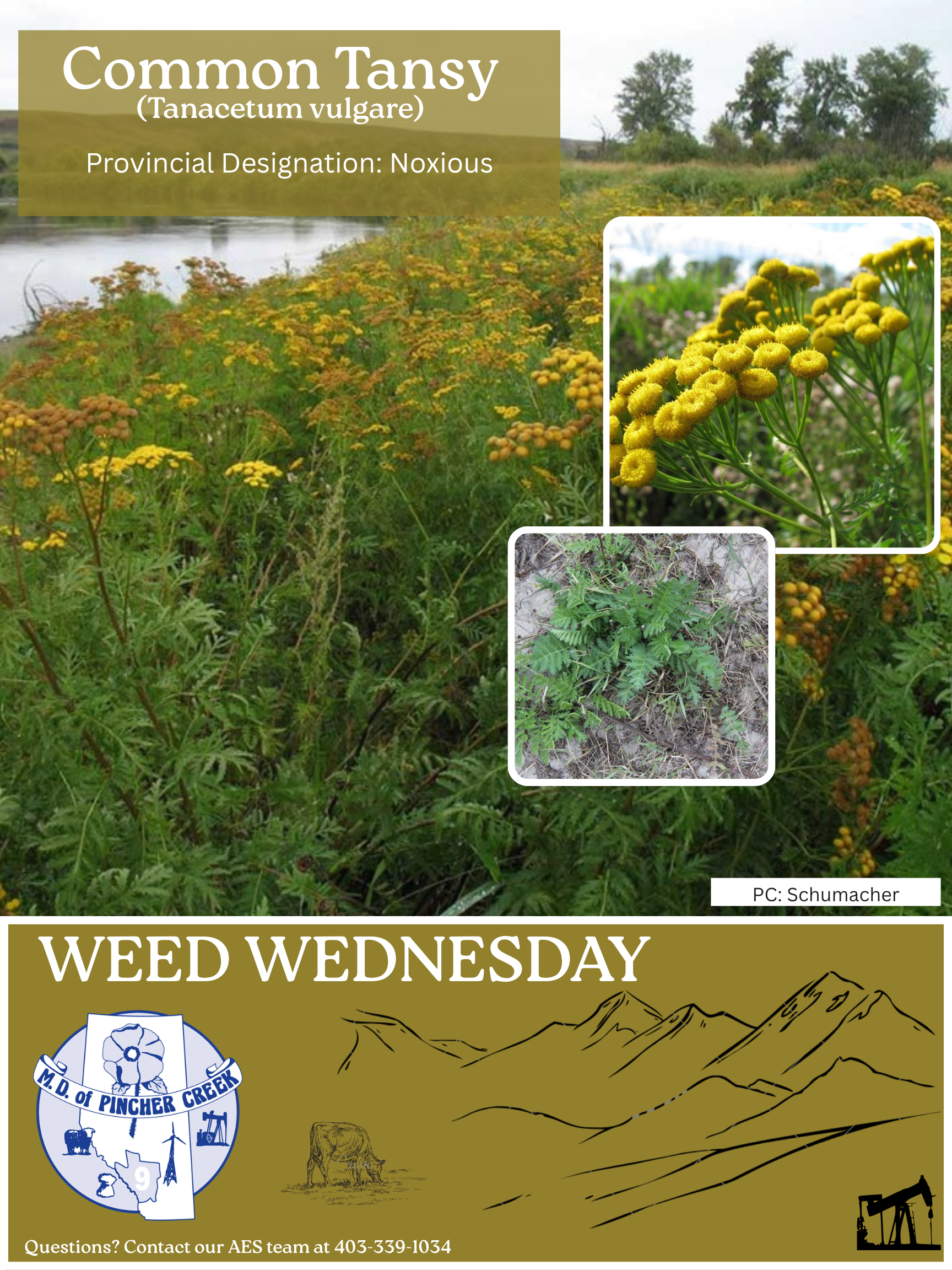
Common tansy is a perennial forb, which is native to Europe and was introduced for its medicinal and embalming uses. Common tansy can be bought in “wildflower” mixes, but is considered a noxious weed in Alberta and should never be purchased and planted.
The ideal habitat for Common tansy is full sun and fertile, well-drained soil, typically found in disturbed soil. The entire plant can grow up to 1.5 m tall. The stems of Common tansy are branched, erect and often purplish-red, with glands peppering the outside; many stems can grow from one plant. Leaves alternate on the stem and are divided into numerous narrow individual leaflets with toothed fern-like edges. Flowers are yellow, numerous and button-like, growing in dense, flat-topped clusters of 20-100 at the tops of stems. Seeds are yellowish brown with short-five toothed crowns, which a mature plant can produce 50,000 seeds in a single life cycle. Common tansy reproduces by seeds and a deep and robust root system, which make regrowth likely when roots are cut.
A native look-a-like is Bracted lousewort (Pedicularis bracteosa), the main difference is when flowering, the plant is spike-like, and an off-pale yellow to purple flower. Common tansy is not palatable to cows and horses but can be grazed by sheep and goats. Cultivation is not an effective control method, due to its rhizomatous root system. Regular mowing can reduce seed production but must be done repetitively throughout the growing season. Mowing or cutting is best used in tandem with herbicide applications.
Chemicals registered for use on Common Tansy are Aminopyralid; alone or in a product mix with 2-4-D, Chlorsulfuron; alone or in a product mix with metsulfuron-methyl, Metsulfuron-methyl; alone or in a product with Aminopyralid and Tribenuron-methyl. Always read and follow the label. Consult with our Agricultural Fieldsman for more information.
Return to News & Events